Support our educational content for free when you purchase through links on our site. Learn more
Marine Electronics Adoption Rates: What Boaters Use 📊

Marine electronics adoption rates are rising, but market growth figures do not tell us what percentage of recreational boaters own each device. Reports estimate the global marine electronics market growing by roughly 5% annually, while actual equipment use varies widely by boat, activity, location, and budget.
We’ve seen a familiar scene at the dock: one skipper confidently checks a chartploter, another taps a phone for directions, and a third trusts the depth sounder they’ve used for years. The lesson? The best electronics are the ones suited to your trips—and that you know how to use.
Key Takeaways
- Market growth is not an ownership rate. Sales and revenue forecasts cannot establish what percentage of boaters use a chartploter, radar, or fish finder.
- Adoption depends on the boat and its purpose. Anglers, cruisers, sailors, and commercial operators have different equipment needs.
- Connected systems are expanding, combining navigation, sonar, radar, communications, and engine data on multifunction displays.
- Integration has trade-offs. Compatibility, installation, subscriptions, training, and single-device failure risks all matter.
- Choose for real-world use: match equipment to your waters, trips, and experience, then keep a backup navigation and communication plan.
Table of Contents
- ⚡ Quick Tips and Facts: Marine Electronics Adoption Rates
- 🌊 How Marine Electronics Adoption Has Evolved
- 📊 What “Adoption Rate” Means in the Marine Electronics Market
- Adoption, Ownership, Installation, and Usage: Key Differences
- How Researchers Measure Marine Technology Adoption
- 🧭 Marine Electronics Adoption Rates by Equipment Type
- Chartploters and Multifunction Displays
- Marine Radar and Collision-Avoidance Systems
- Fish Finders, Sonar, and Forward-Looking Imaging
- GPS, GNSS, and Electronic Navigation
- VHF Radios, AIS, and Satellite Communications
- Autopilots and Assisted Steering
- Digital Switching, Sensors, and Engine Monitoring
- Onboard Wi-Fi, Apps, and Connected Boating
- 🚤 Adoption Rates by Vessel Type and Boater
- Recreational Boats, Sailboats, and Fishing Boats
- Commercial Vessels, Workboats, and Passenger Craft
- New Boats Versus Existing Flets
- First-Time Buyers, Experienced Owners, and Charter Operators
- 📈 Market Size, Growth, and Forecasts for Marine Electronics
- How to Read Market Share and Adoption Forecasts
- Why Forecasts Differ Across Research Reports
- 🌍 Regional Marine Electronics Adoption Trends
- North America
- Europe
- Asia-Pacific
- Latin America, the Middle East, and Africa
- ✅ What’s Driving Marine Electronics Adoption
- Safety, Situational Awareness, and Regulatory Requirements
- Easier Navigation and Better Fishing Information
- Falling Bariers to Connectivity and System Integration
- New-Boat Technology and Owner Expectations
- ⚠️ Bariers Slowing Adoption
- Equipment Costs, Installation, and Upgrade Complexity
- Learning Curves, Reliability Concerns, and Digital Fatigue
- Compatibility, Cybersecurity, and Connectivity Gaps
- 🔭 Emerging Trends Shaping Adoption
- AI-Assisted Navigation and Smarter Sonar
- Cloud Services, Mobile Apps, and Remote Monitoring
- Autonomous and Semi-Autonomous Vessel Technology
- Sustainable Boating and Electrification
- 🏷️ Leading Marine Electronics Brands and Market Competition
- Garmin, Raymarine, Simrad, Lowrance, and Furuno
- Brand Ecosystems, Interoperability, and Dealer Support
- 🛠️ How to Choose Electronics That Boaters Will Actually Use
- Matching Equipment to Your Boat and Typical Trips
- Planning a Marine Electronics Upgrade
- Questions to Ask an Installer or Boat Dealer
- 🔮 The Future of Marine Electronics Adoption
- Conclusion
- Recommended Links
- FAQ
- Reference Links
⚡ Quick Tips and Facts: Marine Electronics Adoption Rates
For context on boat ownership and the size of the recreational boating landscape, see our boat statistics guide. One crucial distinction: marine electronics market growth is not the same thing as the percentage of boaters who own or use a particular device. Public market reports commonly estimate industry revenue; they do not consistently survey boat owners about equipment use.
| Quick fact | What it means for boaters |
|---|---|
| Global market estimates vary by research firm | Grand View Research estimated the market at USD 6.54 billion in 2023 and projected a 5.3% CAGR from 2024 to 2030. Market.us reported USD 5.85 billion in 2023 and forecast 5.2% CAGR. Different market definitions and research methods can produce different totals. |
| Navigation electronics form a major market segment | GPS/GNSS, chartploters, radar, sonar, and integrated navigation systems are central to both safety and route planning. |
| Commercial shipping and recreational boating are not interchangeable | A commercial ship’s regulated bridge suite tells us little about the share of small-boat owners with a fish finder. |
| Installed equipment is not necessarily used well | A chartploter is only helpful if you know how to read it, keep charts current, and maintain a backup plan. |
| Connectivity is growing, but paperless boating is not a safe assumption | Electronic tools can support navigation; they should not make you dependent on a single display, network, or power source. |
Our practical take: start with the job you need the electronics to do. For many recreational boaters, dependable navigation, a suitable marine radio, and an understanding of the equipment matter more than owning the largest screen on the dock.
Useful starting points include the U.S. Coast Guard’s boating safety resources and our boating guides. For market context and more boating coverage, browse Boat Industry News.
🌊 How Marine Electronics Adoption Has Evolved
Marine electronics have shifted from a handful of separate instruments to increasingly connected onboard systems. Early recreational setups often centered on a compass, paper charts, depth sounder, and VHF radio. Today, a single multifunction display (MFD) may bring charting, GPS, radar, sonar, AIS targets, engine data, and networked sensors onto one screen.
That change is more than a tidier helm. Modern systems can share information, but they also introduce software, compatibility, and training questions that older stand-alone instruments did not.
From stand-alone instruments to connected systems
| Stage | Typical capabilities | What changed |
|---|---|---|
| Traditional navigation | Compass, paper charts, depth sounder, VHF | Information was separate and often interpreted manually |
| Early electronic adoption | GPS, chartploter, basic fish finder | Position and depth became easier to read at a glance |
| Networked electronics | MFDs, radar, AIS, engine data, NMEA networks | Multiple devices can share data and present it in one place |
| Connected boating | Mobile apps, remote monitoring, cloud services | Some planning, updates, and monitoring extend beyond the helm |
Manufacturers such as Garmin and Raymarine offer integrated marine electronics ecosystems, while Furuno serves recreational and commercial users. The right system depends on the boat, intended use, existing equipment, and the support available where you cruise.
Adoption is not the same as technological progress
New features may arrive quickly, but uptake varies. A new boat may leave the factory with an integrated display; an older boat may have a reliable stand-alone depth sounder and no reason to replace it. In our boating experience, the most useful upgrade is often the one that solves a real problem without making the helm harder to use.
A connected helm can also create a single point of failure. If every instrument relies one network or display, a fault may affect more than one function. We like integration, but we still value independent backups and knowing how to use them.
📊 What “Adoption Rate” Means in the Marine Electronics Market
When a market report says marine electronics adoption is rising, it may refer to industry sales, installed equipment, or technology use across a vessel category. Those are related measures, but they are not the same statistic.
Adoption, Ownership, Installation, and Usage: Key Differences
| Term | What it measures | Example |
|---|---|---|
| Market growth | Revenue or unit sales over time | More chartploters sold in a year |
| Ownership penetration | Share of a surveyed group that owns a device | Percentage of surveyed boat owners with a chartploter |
| Installation rate | Share of vessels fitted with a device | Percentage of a fleet equipped with AIS |
| Active usage | How often owners use the device | Whether the chartploter is used on most trips |
| Integration | Whether devices share data or controls | Radar overlay displayed on an MFD |
A market CAGR cannot tell you that a specific percentage of boaters owns a GPS or fish finder. It describes the pace of estimated market expansion, not owner-level adoption.
How Researchers Measure Marine Technology Adoption
Researchers may combine manufacturer revenue, vessel registrations, shipment data, interviews, and regional sales. Public sources often differ in:
- What equipment they include: hardware only, or hardware plus software and services.
- Which customers they count: recreational, commercial, military, or all segments.
- Whether they track new sales, replacement purchases, or installed fleets.
- How they define product categories such as navigation systems or communication equipment.
- The geographic and forecasting period covered.
For that reason, we recommend using market reports to understand direction and business context, not as a direct measure of the percentage of recreational boaters with a particular device.
🧭 Marine Electronics Adoption Rates by Equipment Type
There is no single, reliable, public adoption percentage for every device across all recreational boats. Equipment varies with boat size, location, activity, budget, and local requirements. This table focuses on practical role and adoption context rather than inventing unsupported penetration numbers.
| Equipment | Main purpose | Common users | Practical adoption context |
|---|---|---|---|
| Chartploter / MFD | Position, charts, and connected data | Cruising, fishing, sailing | Common on many equipped boats; standalone or integrated |
| Radar | Detect targets and land in limited visibility | Offshore and larger-vessel operators | More relevant as range, weather exposure, and operating conditions increase |
| Fish finder / sonar | Show depth, structure, and fish-related information | Anglers and boaters needing depth awareness | Especially relevant to fishing; transducer choice matters |
| GPS / GNSS | Positioning and navigation data | Nearly all modern navigation setups | Frequently built into chartploters and other devices |
| VHF / AIS | Communication and vessel identification | Coastal, commercial, and safety-conscious operators | Radio use and carriage requirements depend on vessel and jurisdiction |
| Autopilot | Maintain a heading or follow a route | Cruisers, sailboats, larger boats | Benefits rise with trip length and operating conditions |
| Digital switching / monitoring | Centralize onboard systems and diagnostics | Newer boats and complex installations | More likely on factory-integrated vessels and upgraded systems |
| Apps / onboard connectivity | Planning, weather, and remote data access | Broad range of recreational boaters | Smartphone use complements, but does not replace, marine equipment |
Chartploters and Multifunction Displays
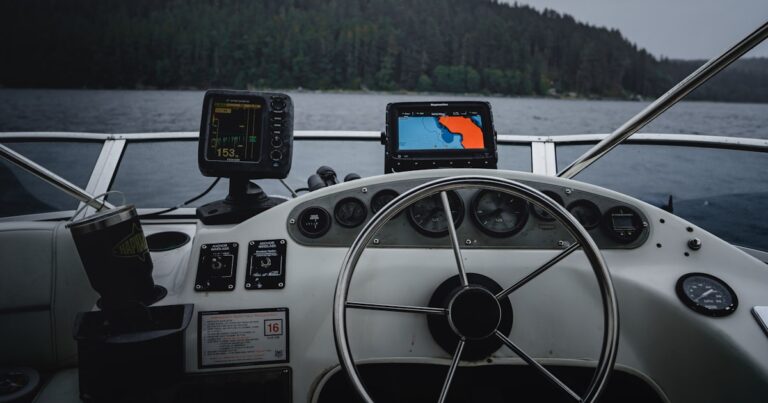
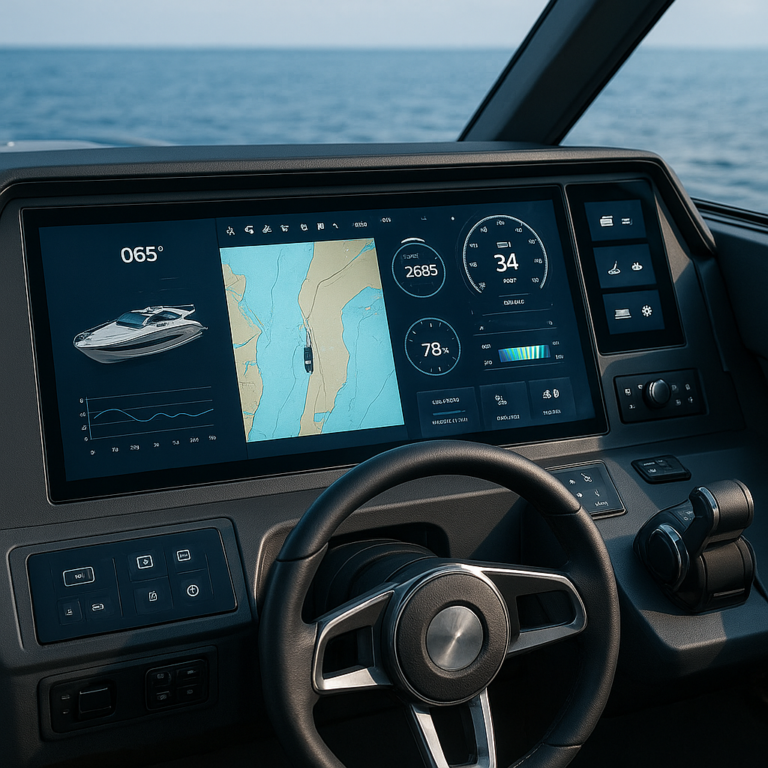
A chartploter combines electronic charts with position data. An MFD can add radar, sonar, AIS, engine readings, and other networked information. That can make a helm more legible, but it also means one screen may be asked to do a lot.
Before choosing one, consider:
- Screen readability in direct sunlight and at your normal viewing distance.
- Controls and menus you can operate in chop, gloves, or rain.
- Chart coverage and update policy for the waters you actually use.
- Compatibility with the boat’s existing transducer, radar, radio, and network.
- Backup navigation if the display loses power or fails.
The Garmin chartploter range and Raymarine Axiom displays are examples of current MFD families. A smart display is not a substitute for understanding your route.
Marine Radar and Collision-Avoidance Systems
Radar can help identify land, vessels, and other targets, especially when visibility is poor. It is not magic fog vision: target interpretation takes practice, and performance depends on the radar, installation, sea conditions, range settings, and operator skill.
Brands including Furuno and Garmin offer marine radar systems. Radar and AIS serve different purposes: radar detects reflected energy from targets, while AIS displays transmitted vessel information from appropriately equipped vessels. Neither reveals every hazard.
Fish Finders, Sonar, and Forward-Looking Imaging
A fish finder uses sonar to show underwater information. Depending on the system, this may include depth, bottom structure, and returns that anglers interpret as fish. Forward-looking and scanning sonar add other views, but results depend heavily on transducer installation, water conditions, settings, and operator experience.
The video referenced earlier, the first YouTube video, makes a useful consumer point: the transducer can matter more than a bigger display. It also flags subscription costs, software-update hicups, and the temptation to pay for a premium ecosystem when a mid-range unit may meet your needs. Those are sensible buying cautions, though individual performance varies by model and installation.
Look at Lowrance fish finders, Garmin sonar and fish-finding products, and Huminbird. Compare transducer type, mounting options, frequency support, chart compatibility, and warranty—not just screen size.
GPS, GNSS, and Electronic Navigation
GPS is one satellite navigation system; GNSS is the broader term for systems that use satellite constellations. A chartploter commonly combines satellite position with electronic charts, but position accuracy does not guarantee that the chart is current or that your route is safe.
Use electronic navigation alongside sound judgment, local notices, and appropriate backups. The U.S. Coast Guard publishes Navigation Rules and related safety information; boaters should also consult the relevant local authority for charts and notices.
VHF Radios, AIS, and Satellite Communications
A marine VHF radio supports vessel-to-vessel and vessel-to-shore communication. AIS can help display information broadcast by equipped vessels, while satellite communications provide connectivity beyond ordinary terrestrial coverage.
These technologies have different roles:
- VHF: local marine voice communication and safety calls.
- AIS: vessel identity and movement information when transmissions are available.
- Satellite communications: voice or data coverage where cellular service is unavailable.
The U.S. Coast Guard’s VHF radio guidance explains marine communication basics. Icom and Standard Horizon are established marine radio brands. Always check licensing, carriage, and operating rules for your boat and location.
Autopilots and Assisted Steering
Autopilots can reduce the workload of holding a heading or following a route, especially on longer trips. They do not watch for traffic or replace a person standing a proper lookout. A route-following feature also requires a correctly configured navigation system and an operator ready to take control.
Garmin and Raymarine offer marine autopilot systems. Before buying, confirm steering-system compatibility, installation requirements, and how the unit behaves when navigation data or power is lost.
Digital Switching, Sensors, and Engine Monitoring
Digital switching can centralize control of lights, pumps, and other onboard functions. Engine-monitoring systems may show operating data and alerts. These capabilities can simplify a modern helm, but the installation is more involved than adding a plug-in gadget.
Ask the builder or installer:
- Which functions are network-dependent?
- What can be controlled manually if the screen or network fails?
- Are alarms visible or audible from the helm?
- Can the system be serviced locally?
- Does it use open standards or proprietary components?
For systems and installation context, explore Boat Manufacturers and our boat buying guide.
Onboard Wi-Fi, Apps, and Connected Boating
Mobile apps help with trip planning, weather checks, manuals, and some forms of device control. They can be convenient at the dock or as a secondary tool, but phones are vulnerable to water, heat, battery loss, and poor signal.
Use a phone as a helpful companion, not your only navigation plan. Download charts or relevant information in advance, protect devices from spray, and know what remains usable without cellular service.
🚤 Adoption Rates by Vessel Type and Boater
Electronics adoption differs because boats do different jobs. A small inland fishing boat, a bluewater sailboat, and a commercial vessel do not need identical systems.
Recreational Boats, Sailboats, and Fishing Boats
- Fishing boats: fish finders and sonar are often high priorities; charting and GPS support safe returns and access to fishing grounds.
- Sailboats: navigation, wind data, depth, autopilot, and communication may be central to a cruising setup.
- Power cruisers: chartploters, radar, VHF, engine monitoring, and autopilot can reduce workload on longer trips.
- Small inland boats: a phone and basic depth display may be enough for familiar, sheltered waters, but conditions and local regulations still matter.
- Personal watercraft and simple runabouts: equipment needs depend on operating area, trip type, and applicable rules.
A useful question is not “What does everyone install?” It is “What information do I need to operate this boat safely and confidently?”
Commercial Vessels, Workboats, and Passenger Craft
Commercial vessels may face operational and regulatory requirements that do not apply to a private recreational boat. Market.us identifies merchant marine as a major market segment, while broader market reports also include commercial, recreational, and military applications. That is an industry view, not proof that commercial installation rates can be applied to leisure boats.
International requirements vary by vessel category and voyage. The International Maritime Organization provides information on maritime safety and navigation measures; operators should verify which rules apply to their vessel and flag state.
New Boats Versus Existing Flets
New boats are more likely to be offered with integrated displays, factory-installed sensors, and networked controls. Older boats may have dependable electronics but face compatibility challenges during upgrades.
| Situation | Typical advantage | Common challenge |
|---|---|---|
| New boat | Equipment can be designed as a system from the start | Factory package may include features the owner rarely uses |
| Existing boat | Owner can upgrade selectively | Old wiring, transducers, and networks may limit compatibility |
| Mixed-brand setup | More choice across categories | Data sharing and control may not work as expected |
| Single-brand ecosystem | Simpler integration in some configurations | Greater dependence one manufacturer’s compatibility and support |
On an older boat, inspect wiring, power capacity, mounting space, and the existing network before ordering a new display. A marine electronics installer can often identify a hidden compatibility issue before it turns into a dockside puzzle.
First-Time Buyers, Experienced Owners, and Charter Operators
First-time owners may benefit most from simple, well-supported equipment and hands-on instruction. Experienced boaters may value integration, advanced sonar, or remote monitoring. Charter operators often prioritize reliability, fast troubleshooting, clear controls, and minimizing downtime.
Our advice across all three groups is the same: buy for your real trips, not for the most impressive product demonstration. A feature you cannot interpret or maintain adds complexity, not confidence.
📈 Market Size, Growth, and Forecasts for Marine Electronics
Market reports help show the scale and direction of the marine electronics industry. They do not usually publish directly comparable percentages for how many recreational owners use each product.
| Research source | Reported 2023 market estimate | Growth outlook | Caution |
|---|---|---|---|
| Grand View Research | USD 6.54 billion | 5.3% CAGR, 2024–2030 | Estimate reflects that report’s market definition |
| Market.us | USD 5.85 billion | 5.2% CAGR; forecast endpoint is stated inconsistently in the supplied summary | Check the report’s current page and forecast period before citing an endpoint |
| Fortune Business Insights | Not independently confirmed here | Report page may require verification or access | Do not infer details from a security-check screen |
Grand View Research attributes growth to the “increasing adoption of advanced marine technologies,” while Market.us points to demand for navigation, communication, safety, and efficiency. Those explanations are broadly consistent. The precise dollar totals differ because firms can define the market and model sales differently.
How to Read Market Share and Adoption Forecasts
A forecast is an estimate, not a measurement of future sales. A reported share such as “navigation systems lead” may refer to revenue, not the number of boats carrying navigation equipment.
Before relying on a market figure, check:
- The base year and forecast period.
- The market scope: hardware, software, services, or a combination.
- The customer categories included.
- The metric: revenue share, unit sales, fleet installation, or ownership survey.
- The data date and whether the report has been updated.
Why Forecasts Differ Across Research Reports
Market.us and Grand View Research report different 2023 values, but their growth estimates are close: 5.2% versus 5.3% CAGR, as summarized in their reports. That difference does not automatically mean one is wrong. It may reflect different inclusions, source data, currency assumptions, or estimation methods.
What should you trust? For market size, compare methodology and definitions. For equipment rules, go to official regulatory sources. For product fit, check manufacturer documentation and have an installer confirm compatibility. For consumer adoption percentages, look for a transparent survey that specifies who was asked and when.
🌍 Regional Marine Electronics Adoption Trends
Marine electronics demand reflects local boating patterns, fleet composition, regulations, infrastructure, and access to service. Regional market share is not the same as the proportion of local boat owners with a specific device.
North America
North America has a substantial recreational boating market and a large commercial maritime sector. Market.us estimates that the region held 38.3% of the marine electronics market in 2023. Treat that as a share of estimated market value, not as an ownership rate among North American boaters.
Safety expectations, boating activity, fishing, and established marine-service networks contribute to demand. For local rules and safety information, consult the U.S. Coast Guard and the relevant state or provincial authority.
Europe
Europe includes varied coastal, inland, commercial, and recreational boating environments. Requirements differ by vessel, flag, and operating area. Integrated navigation and communication technologies may be particularly relevant to commercial fleets and vessels operating offshore, but a single region-wide percentage would conceal major differences between countries and boat types.
Asia-Pacific
Asia-Pacific encompasses major shipbuilding and maritime-trade markets as well as rapidly changing recreational boating sectors. Commercial fleet needs, port development, and regional manufacturing can influence demand. Local service access matters: a sophisticated system is less attractive if the owner cannot get it installed, supported, or repaired nearby.
Latin America, the Middle East, and Africa
Adoption can differ widely across these regions according to fleet investment, import access, infrastructure, operating conditions, and repair networks. Market growth may be driven by commercial shipping or offshore activity even where recreational electronics ownership remains limited. Always check the local chart, communication, and carriage requirements for your specific waters.
✅ What’s Driving Marine Electronics Adoption
Market researchers commonly identify safety, navigation accuracy, operational efficiency, connectivity, and regulatory needs as drivers. For recreational boaters, ease of use and confidence on unfamiliar water can be just as persuasive as advanced features.
Safety, Situational Awareness, and Regulatory Requirements
Marine electronics can help operators understand position, traffic, depth, weather, and vessel condition. They support decision-making; they do not remove the need for a lookout, local knowledge, communication skills, or an emergency plan.
The U.S. Coast Guard and International Maritime Organization provide safety information for different boating and maritime contexts. Requirements depend on vessel type, use, and jurisdiction, so do not assume commercial carriage rules apply to a private boat.
Easier Navigation and Better Fishing Information
Chartploters and sonar can make information easier to access, especially when a boater is unfamiliar with an area or looking for underwater structure. The benefit depends on good chart data, appropriate settings, and interpretation.
For anglers, a better transducer may produce a more meaningful improvement than a larger screen. For cruisers, a clear chart display and simple route workflow may matter more than a long list of advanced features.
Falling Bariers to Connectivity and System Integration
Networked displays can combine information from multiple devices and reduce the need to move between separate instruments. Mobile apps add planning and service tools. As Grand View Research and Market.us describe, connected and integrated systems are contributing to industry growth.
But integration is only useful when the components communicate reliably. Confirm network standards, device compatibility, software support, and the availability of local service before building an elaborate system.
New-Boat Technology and Owner Expectations
Factory-fitted displays can raise expectations: owners increasingly want clear charting, easy device pairing, engine data, and phone-friendly tools. Builders and suppliers respond with more integrated packages, discussed across Boat Manufacturers and Boat Industry News.
A factory package is convenient, but ask which components are optional, what data subscriptions are required, and whether independent controls remain available.
⚠️ Bariers Slowing Adoption
The cost of marine electronics is not limited to the box. Installation, wiring, charts, subscriptions, training, repair, and future upgrades can all affect the decision. We have watched boaters buy a capable display, then discover the real headache was an incompatible transducer or aging network.
Equipment Costs, Installation, and Upgrade Complexity
The upfront purchase is only one part of ownership. A new installation may need a transducer, antenna, mount, cabling, network components, or professional labor. Larger retrofits may also require changes to power distribution or helm layout.
The video linked earlier, the first YouTube video, highlights several consumer pitfalls: a larger screen does not automatically improve sonar, chart subscriptions can add recurring costs, and software updates sometimes need a follow-up patch. These are useful prompts for questions—not proof that every device has the same limitations.
Learning Curves, Reliability Concerns, and Digital Fatigue
A display full of icons is not automatically safer. New users may struggle with menus, alarms, radar settings, or chart layers. Updates can alter workflows, while a failed unit can be unsettling if the operator has no backup.
Helpful steps:
- Ask the dealer to demonstrate the features you will actually use.
- Practice at the dock before relying on a feature underway.
- Save a simple route and test the device’s controls.
- Keep paper or independent electronic backup appropriate to your trip.
- Learn the radio and emergency procedures before you need them.
Compatibility, Cybersecurity, and Connectivity Gaps
Older vessels can have mixed-generation wiring, proprietary connections, or legacy equipment that does not share data smoothly with new devices. Network security matters too as boats gain Wi-Fi, cloud services, and connected control systems.
Before upgrading, document model numbers and network details, then ask the manufacturer or installer to verify compatibility. Keep software current according to manufacturer guidance, use secure network credentials, and know how to operate critical equipment if internet access disappears.
🔭 Emerging Trends Shaping Adoption
The market is moving toward more connected, automated, and data-rich vessels. That does not mean every recreational boat needs advanced autonomy. In practical terms, the trend to watch is whether new features make boating safer and easier to understand, rather than simply adding another menu.
AI-Assisted Navigation and Smarter Sonar
Manufacturers continue to develop tools that simplify target interpretation, sonar display, route planning, and alerts. These features may help users process more information, but operators still need to verify what the system is showing and follow safe navigation practices.
Cloud Services, Mobile Apps, and Remote Monitoring
Connected services can support software updates, trip planning, device control, and remote vessel checks. Availability depends on the product, subscription, and network coverage. Check what functions work offline, what data is stored, and what happens if a service is discontinued.
Autonomous and Semi-Autonomous Vessel Technology
Autonomy is an emerging field, particularly in commercial and specialized maritime applications. Recreational autopilots are not autonomous vessel systems: they assist steering but do not take responsibility for safe operation. The IMO’s work on maritime autonomous surface ships provides context on the regulatory and technical discussion.
Sustainable Boating and Electrification
Electric and hybrid propulsion, battery monitoring, energy management, and solar charging increase the value of accurate onboard power data. Electronics can help owners monitor energy use, but system design must account for battery capacity, charging sources, and safe installation.
For boat-lifestyle coverage and practical ownership context, visit Boat Lifestyle.
🏷️ Leading Marine Electronics Brands and Market Competition
Several established brands serve recreational and commercial users. Their product ranges overlap, but availability, features, support, network compatibility, and installation requirements vary by model.
| Brand | Commonly associated with | What to compare |
|---|---|---|
| Garmin | Chartploters, sonar, radar, autopilots, wearables | Chart options, transducer compatibility, network integration |
| Raymarine | MFDs, radar, autopilots, sailing instruments | Existing network, display controls, dealer support |
| Simrad | Navigation, radar, sonar, autopilots | Boat type, system integration, installation options |
| Lowrance | Fishing electronics, chartploters, sonar | Sonar needs, transducer, mapping support |
| Furuno | Commercial and recreational navigation, radar, sonar | Operating environment, professional service, system scope |
| Huminbird | Fishing electronics and sonar | Transducer, mapping, fishing-specific features |
| Icom | Marine radios and communications | Radio type, installation, operating rules |
| Standard Horizon | Marine VHF radios and communications | DSC features, antenna setup, local support |
Garmin, Raymarine, Simrad, Lowrance, and Furuno
No brand wins every category for every boat. A fishing-focused owner may prioritize sonar and mapping; a cruiser may care more about radar, autopilot, and clear route planning. Commercial users may require different equipment, certifications, and service arrangements.
Market.us lists companies including Furuno, Garmin, Icom America, Japan Radio Co., Kongsberg, Navico, Raymarine, Teledyne Technologies, and SRT Marine Systems. That list reflects industry participation, not a universal ranking of product quality.
Brand Ecosystems, Interoperability, and Dealer Support
A single-brand setup may simplify integration, but it can narrow future choices. A mixed-brand helm can work well when the equipment supports the required data and controls, but compatibility must be checked at the model level.
Before purchasing, verify:
- The exact network standard and required adapters.
- Whether the desired data is read-only or can be controlled from another device.
- Chart compatibility and subscription terms.
- Local installation and repair support.
- Firmware history and manufacturer documentation.
🛠️ How to Choose Electronics That Boaters Will Actually Use
Start with the water, not the catalogue. A boater on familiar lakes has different requirements from someone crossing exposed coastal water after dark.
Matching Equipment to Your Boat and Typical Trips
Use this quick decision sequence:
- Write down your real trips. Note waterway, range, season, visibility, and crew experience.
- Identify the problem. Is it navigation confidence, communication, fish-finding, engine monitoring, or reduced steering workload?
- Check what is already installed. Record device models, transducers, antennae, wiring, and network connections.
- Prioritize essential functions. Select equipment that addresses the greatest operational need.
- Plan backups. Consider what you will do if power, display, GPS input, or connectivity fails.
- Test before a demanding trip. Learn the menus, alarms, and normal operation close to shore.
Planning a Marine Electronics Upgrade
A thoughtful upgrade is usually less frustrating than buying first and troubleshooting later.
| Step | Action | Why it helps |
|---|---|---|
| 1 | List existing components and model numbers | Reveals possible compatibility limits |
| 2 | Define the job the new device must do | Prevents feature creep |
| 3 | Confirm transducer and network requirements | Avoids expensive installation surprises |
| 4 | Review charts, subscriptions, and update policies | Makes ongoing obligations visible |
| 5 | Ask about support and warranty | Matters when equipment fails away from home |
| 6 | Budget for installation and training | Helps the system work as intended |
| 7 | Keep an independent backup plan | Reduces dependence one screen |
Questions to Ask an Installer or Boat Dealer
- Will this model work with my current transducer, radar, radio, and network?
- What additional cables, adapters, or power changes are required?
- Which functions need a subscription or internet connection?
- What remains operational if the MFD fails?
- Can I try the interface before buying?
- Who services the system locally?
- Are software updates optional, recommended, or needed for compatibility?
- What training is included?
🔮 The Future of Marine Electronics Adoption
The market outlooks from Grand View Research and Market.us point to steady industry growth, with both projecting roughly 5% annual growth over their stated forecast periods. That is an estimate of market expansion, not a promise that every boat owner will adopt a new device at the same pace.
We expect continued demand for integrated displays, connectivity, safer communications, monitoring, and more capable sonar. The most useful developments will be the ones that make information easier to interpret and equipment easier to maintain. And that brings us back to the question behind every adoption statistic: does the technology make the boat safer and simpler to operate, or merely busier at the helm? Our answer is to favor clear, compatible systems, practice with them, and keep a backup plan.