Support our educational content for free when you purchase through links on our site. Learn more
Who Makes the Most Boats? 15 Leaders 🚤

Groupe Beneteau and Brunswick are the strongest answers for high-volume recreational boat building, while Fincantieri leads many broad revenue-based rankings because it builds enormous commercial ships and luxury vessels. The winner depends on whether you mean unit production, revenue, sailboats, yachts, or recreational boats.
That is the catch hiding beneath the question “Who makes the most boats?” A company producing thousands of fishing boats may build far more hulls than a superyacht yard, yet earn less from one year of production than a builder delivering a handful of floating palaces.
We have seen this confusion play out at boat shows: one booth packed with anglers, another surrounded by wakeboard families, and a third displaying a yacht with an engine room larger than some apartments. All three manufacturers are successful, but they are playing very different games.
This guide compares the world’s biggest boat manufacturers, including Brunswick, Groupe Beneteau, Malibu Boats, MasterCraft, Feretti Group, Azimut|Benetti, Sanlorenzo, and other major builders. By the end, you’ll know which companies lead each boating category—and why “most” is a slipperier word than a wet swim platform.
Key Takeaways
- Brunswick is one of the strongest candidates for the largest broad recreational-boat group, with brands spanning fishing boats, pontons, runabouts, yachts, and marine propulsion.
- Groupe Beneteau is a global powerhouse in production sailboats, cruising yachts, powerboats, and catamarans.
- Fincantieri often leads broad revenue comparisons, but its figures include large commercial, defense, and passenger-ship operations—not just recreational boats.
- Azimut|Benetti, Feretti Group, Sanlorenzo, Princess, and Lürssen dominate high-value luxury and superyacht segments.
- Malibu Boats, MasterCraft, and Correct Craft are leading premium watersports manufacturers, but they do not necessarily build the most boats overall.
- Unit volume, revenue, brand ownership, and yacht deliveries measure different things, so rankings must be read with their methodology in mind.
- The best boat manufacturer for you depends on use, dealer support, hull design, service access, and resale value—not merely corporate size.
Table of Contents
- ⚡️ Quick Tips and Facts: Who Makes the Most Boats?
- 🧭 What Does “Most Boats” Actually Mean?
- Unit Sales vs. Revenue, Fleet Size, and Production Volume
- Recreational Boats, Sailboats, Yachts, and Commercial Vessels
- 🏭 The Biggest Boat Manufacturers by Production and Global Reach
- How We Compare Boat Builders Fairly
- Who Sells the Most Recreational Boats?
- Who Builds the Most Sailboats?
- Who Produces the Most Luxury Yachts?
- 🚤 15 Boat Companies That Build the Most Vessels
- 1. Groupe Beneteau
- 2. Brunswick Corporation
- 3. Yamaha Motor
- 4. Groupe Bénéteau’s Jeanneau and Prestige Brands
- 5. Malibu Boats
- 6. MasterCraft Boat Holdings
- 7. Marine Products Corporation
- 8. Correct Craft
- 9. Azimut|Benetti Group
- 10. Feretti Group
- 11. Sanlorenzo
- 12. Princess Yachts
- 13. Sunseker International
- 14. HanseYachts AG
- 15. Bavaria Yachtbau
- 🌊 Which Company Makes the Most Boats in the United States?
- The Largest U.S. Recreational Boat Builders
- Popular American Brands for Fishing, Pontoon, Wake, and Runabout Boats
- ⛵ Who Builds the Most Sailboats Worldwide?
- Beneteau, Jeanneau, and the Global Sailing Market
- Catamaran Manufacturers With the Highest Production
- 🛥️ Who Is the Largest Yacht Manufacturer in the World?
- The Leading Yacht Builders by Revenue and Deliveries
- Mass-Production Yachts vs. Custom Superyachts
- How Yacht Market Share and Backlogs Are Measured
- 💎 What Is a Mega Yacht? Size, Cost, and Builders
- Superyacht, Megayacht, and Gigayacht Definitions
- The Companies Building the World’s Largest Private Yachts
- How Long Does It Take to Build a Mega Yacht?
- 🏢 What Brands Does Groupe Beneteau Own?
- Beneteau, Jeanneau, Lagoon, Prestige, and Excess
- Powerboats, Sailboats, and Yacht Categories
- ⚓ What Brands Does Feretti Group Own?
- Feretti Yachts, Riva, Pershing, and Itama
- CRN, Custom Line, and Wally
- 📊 Boat Manufacturer Revenue, Deliveries, and Market Trends
- How Much Did the Biggest Boat and Yacht Companies Make per Second in 2023?
- Why Revenue Does Not Always Mean More Boats
- The Impact of Supply Chains, Interest Rates, and Boat Demand
- 🧰 How Boats Are Manufactured: Materials, Factories, and Production Methods
- Fiberglass Boat Construction
- Aluminum, Steel, Carbon-Fiber, and Composite Hulls
- Serial Production vs. Hand-Built Yacht Construction
- Where the World’s Boats Are Built
- ✅ How to Choose a Boat From a Major Manufacturer
- Best Boat Brands for Beginners
- Best Manufacturers for Fishing and Offshore Cruising
- Best Brands for Pontoon Boats and Family Recreation
- Best Wakeboard, Wakesurf, and Watersports Boat Brands
- Best Sailboat and Catamaran Manufacturers
- Best Yacht Builders for Long-Range Cruising
- ❌ Common Mistakes When Comparing Boat Brands
- Confusing Brand Ownership With Boat-Building Capacity
- Ignoring Dealer Networks and After-Sales Support
- Overlooking Hull Design, Warranty, and Resale Value
- 🧑 ✈️ Looking to Be the Captain of Your Own Yacht?
- Boat Size, Licensing, and Training Requirements
- Buying New vs. Buying a Used Boat
- Ownership Costs Beyond the Purchase Price
- Charter, Fractional Ownership, and Yacht Management
- 🌍 The Future of Boat Building
- Electric Boats and Hybrid Marine Propulsion
- Sustainable Materials and Cleaner Manufacturing
- Smart Boat Technology and Connected Systems
- Autonomous Boats and Emerging Marine Technologies
- 📚 Useful Links for Boat Buyers and Boaters
- Boat Manufacturer Directories and Industry Associations
- Safety, Registration, and Boating Education Resources
- Boat Shows, Reviews, and Marine Market Data
- 📩 Contact Us
- 🏁 Conclusion: So, Who Really Makes the Most Boats?
- 🔗 Recommended Links
- ❓ FAQ About the World’s Biggest Boat Manufacturers
- Who is the largest boat manufacturer in the world?
- Who makes the most boats in the United States?
- Is Beneteau the biggest boat company?
- What is the richest yacht company?
- Which company makes the most luxury yachts?
- Who owns the most boat brands?
- What is the largest boat manufacturer by revenue?
- What is the difference between a boat builder and a yacht manufacturer?
- 📖 Reference Links
Quick Tips and Facts: Who Makes the Most Boats? ⚡️
The short answer is nobody can claim “the most boats” without defining the measurement first. By overall marine revenue, Fincantieri often tops broad yacht-and-ship rankings. By recreational boat scale and brand breadth, Brunswick is a stronger contender. By production sailboats and cruising yachts, Groupe Beneteau is one of the world’s heavyweight builders.
Our first essential distinction: a company making the most money is not necessarily building the most hulls. A shipyard delivering a handful of enormous yachts can generate more revenue than a factory producing thousands of smaller fishing boats.
For background on fiberglass construction, see our guide to Who Makes Fiberglass Boats? 20 Top Builders 🛥️, then browse our Boat Manufacturers coverage.
| Question | Best-supported answer |
|---|---|
| Largest by broad marine revenue | Fincantieri is frequently cited in revenue-based rankings |
| Largest recreational boat group by portfolio | Brunswick Boat Group is a leading candidate |
| Major global sailboat manufacturer | Groupe Beneteau |
| Major powerboat and yacht group | **Groupe Beneteau, Brunswick, Feretti, Azimut |
| Biggest wakeboat specialist discussed here | Malibu Boats is a major premium watersports brand |
| Most boats by unit count | No consistently published global ranking |
The five facts worth remembering
- “Most boats” can mean unit production, revenue, deliveries, market share, or number of brands.
- Fincantieri’s revenue leadership reflects large ships and luxury yachts, not necessarily the highest unit count.
- Brunswick’s portfolio reaches fishing boats, pontons, sterndrive boats, outboards, and yachts.
- Groupe Beneteau has exceptional global reach across sailboats, powerboats, catamarans, and cruising yachts.
- Boat-show popularity is useful shopper intelligence, but it is not audited production data.
One more wrinkle: company structures change. Brands are acquired, sold, reorganized, or reported inside larger divisions. That is why we trust annual reports, official company filings, and industry associations over a bold ranking with no methodology.
What Does “Most Boats” Actually Mean? 🧭
Search the phrase “Who makes the most boats?” and you’ll find several answers that appear to disagree. Often, they are answering different questions.
A luxury yacht builder may report impressive revenue from a small number of high-value vessels. A pontoon or fishing-boat manufacturer may build many more boats while generating less revenue. Think of it as comparing a bakery selling thousands of rolls with a specialist producing a few spectacular wedding cakes. Both are busy. Only one has a yacht-shaped invoice.
Unit Sales vs. Revenue, Fleet Size, and Production Volume
Here are the main ways boat-industry rankings are calculated:
| Measurement | What it tells you | Main limitation |
|---|---|---|
| Units built | Factory output | Many builders do not publish exact figures |
| Retail unit sales | Boats sold through dealers | Inventory and wholesale timing can distort results |
| Revenue | Financial scale | One superyacht may equal hundreds of small boats |
| EBITDA or profit | Business performance | Not a measure of boat volume |
| Brand count | Market breadth | Owning brands does not prove higher production |
| Backlog | Future demand | Orders may be delayed or canceled |
| Market share | Position in a segment | Usually category-specific, not global |
The National Marine Manufacturers Association tracks the U.S. recreational marine market, but it does not provide one universal leaderboard covering every boat, yacht, ship, and commercial vessel on Earth.
Recreational Boats, Sailboats, Yachts, and Commercial Vessels
The word boat covers a huge range:
- Bass boats
- Center consoles
- Aluminum fishing boats
- Pontoon boats
- Wake and ski boats
- Cabin cruisers
- Sailboats
- Cruising catamarans
- Superyachts
- Commercial workboats
- Passenger vessels
- Naval and government ships
A company such as Brunswick competes heavily in recreational marine products. Fincantieri operates in a much broader shipbuilding universe, including large commercial and defense vessels. Beneteau is especially influential in serial-produced recreational sailboats and cruising yachts.
So, when someone says “the biggest boat company,” ask:
- Bigest by what?
- In which category?
- During which year?
- Does the figure include engines, services, and shipbuilding?
- Are subsidiaries counted separately?
That five-question test prevents a surprising amount of dockside misinformation.
The Biggest Boat Manufacturers by Production and Global Reach 🏭
There is no single, audited global table that ranks every boat builder by unit production. Still, company filings and industry reporting reveal clear leaders.
How We Compare Boat Builders Fairly
At Boat Brands™, we look at six signals:
- Revenue from marine operations
- Number and range of boat brands
- Factory footprint
- Dealer and distribution network
- Reported deliveries order backlog
- Strength within specific categories
We also separate boat builders from engine manufacturers and shipyards. Yamaha, Mercury Marine, Volvo Penta, and Suzuki are enormously important to boating, but selling propulsion systems is not the same as building complete boats.
Who Sells the Most Recreational Boats?
Brunswick Boat Group is one of the strongest answers for broad recreational-boat reach. Its brand family has included names such as:
- Boston Whaler
- Sea Ray
- Bayliner
- Lund
- Harris
- Crestliner
- Lowe
- Quicksilver in selected markets
- Mercury Marine, primarily an engine and propulsion business
Visit the company’s official marine brands information for its current corporate structure. Brunswick’s strength is not one glamorous flagship. It is breadth: fishing boats, pontons, runabouts, offshore boats, and propulsion.
Groupe Beneteau is another major contender, especially when sailboats, catamarans, and cruising yachts are included. Its official brand portfolio demonstrates how wide that reach is.
Who Builds the Most Sailboats?
For serial-produced sailboats, Beneteau and Jeanneau are two of the most recognizable global names. Groupe Beneteau also owns Lagoon, one of the most visible cruising-catamaran brands.
That does not mean every Beneteau-branded boat is built in one enormous factory. Production is distributed across facilities, product lines, suppliers, and regional operations. The result is a broad international footprint rather than a single “world’s largest boat factory.”
Who Produces the Most Luxury Yachts?
This depends heavily on the definition of luxury yacht:
- Azimut|Benetti is a major force in luxury motor yachts and superyachts.
- Feretti Group owns several prestigious yacht brands.
- Sanlorenzo specializes in high-end yachts and superyachts.
- Fincantieri is a massive shipbuilding group with an important superyacht presence through high-value custom projects.
- Lürssen and Feadship are renowned for ultra-large custom superyachts, but they are not high-volume recreational builders.
The key is deliveries versus revenue. A builder delivering 10 custom yachts may rank above a builder delivering 100 smaller yachts by revenue.
15 Boat Companies That Build the Most Vessels 🚤
The following list is not a strict global unit-production ranking. It is a practical comparison of companies with significant scale, market influence, production capability, or revenue across boating categories.
1. Groupe Beneteau
Groupe Beneteau is one of the most important names in recreational boating, with brands spanning:
- Beneteau
- Jeanneau
- Lagoon
- Prestige
- Excess
- Delphia
- Four Winns
- Wellcraft
- Scarab
Its strength is category coverage. A buyer may encounter the group in a sailboat marina, a catamaran charter fleet, a cruising-yacht showroom, or a powerboat dealer.
Why it matters:
- Strong global dealer network
- Major sailboat and catamaran presence
- Broad cruising-yacht portfolio
- Production-oriented manufacturing
- Brand segmentation from accessible cruising boats to luxury yachts
Potential drawback: A large corporate portfolio can make ownership support feel very brand- and dealer-dependent. Your local Jeanneau dealer may provide a very different experience from another region.
Beneteau official website | Jeanneau official website | Lagoon Catamarans official website
2. Brunswick Corporation
Brunswick is one of the broadest recreational marine companies in North America. Its boat brands have included Boston Whaler, Sea Ray, Bayliner, Lund, Harris, Crestliner, Lowe, and others, while Mercury Marine anchors its propulsion business.
Its major advantage is vertical reach. The same corporate family can touch the hull, engine, controls, dealer, and service ecosystem.
Best known for:
- Offshore fishing boats
- Freshwater fishing boats
- Pontoon boats
- Family runabouts
- Luxury day boats
- Outboard propulsion
Our boating perspective: Brunswick’s sheer breadth makes it one of the strongest candidates for “who makes the most recreational boats?” But counting every associated business as boat production would be misleading. Engines and boats are related, not interchangeable.
Brunswick official website | Boston Whaler | Lund Boats | Sea Ray
3. Yamaha Motor
Yamaha is best known to boaters for outboard engines, but its marine influence extends through boat packages, personal watercraft, and selected boat markets.
Yamaha’s strength is engineering, reliability reputation, dealer support, and propulsion integration. It should not automatically be called the world’s largest complete-boat builder.
Best fit for buyers who value:
- Outboard performance
- Widely supported service
- Quiet, efficient propulsion
- Integrated boat-and-engine packages
Yamaha Marine official website
4. Groupe Beneteau’s Jeanneau and Prestige Brands
Although Jeanneau and Prestige sit within Groupe Beneteau, they deserve separate attention because shoppers often compare them directly with independent brands.
- Jeanneau covers sailboats, outboard-powered boats, and cruising yachts.
- Prestige focuses on motor yachts, flybridge yachts, and cruising comfort.
Prestige is particularly relevant to the question “who makes the most yachts?” because it operates in a higher-value segment than many small runabout manufacturers.
Jeanneau official website | Prestige Yachts official website
5. Malibu Boats
Malibu Boats is one of the most recognizable premium watersports manufacturers in North America. Its product families include:
- M-Series
- LSV Series
- MXZ Series
- Crossover/Ski
The company promotes technologies such as Surf Gate, Power Wedge, integrated ballast, preset controls, and watersports-focused hull design on its official website.
Malibu states that it has built boats for more than 40 years and calls its product the “World’s Most Trusted Towboat.” Its LSV line is described as a best-selling traditional-bow series, but that wording does not establish global unit leadership.
| Malibu strength | What it means on the water |
|---|---|
| Surf systems | Faster setup for repeatable wakes |
| Ballast integration | More usable wake and wave shaping |
| Presets | Easier switching between riders |
| Premium interiors | Better comfort for social boating |
| Watersports focus | Less compromise for wake and ski use |
Drawbacks: These systems add complexity, weight, draft, maintenance requirements, and purchase considerations. A Malibu is brilliant at its mission. If your dream is shallow-water fishing and beaching, a specialized skiff may be a better tool.
👉 CHECK PRICE on:
- Malibu Boats: Malibu Official Website | Malibu Boats on Boat Trader
6. MasterCraft Boat Holdings
MasterCraft is a major premium watersports brand with strong recognition in wakeboarding, wakesurfing, and ski boats. The company has also been associated with brands such as Crest and Aviara.
MasterCraft competes directly with Malibu and Nautique on performance, wake shaping, fit and finish, and dealer experience.
Best for:
- Serious wake and surf users
- Buyers who value refined interiors
- Families wanting a premium towboat
- Owners who prioritize factory-integrated systems
7. Marine Products Corporation
Marine Products Corporation is associated with brands including:
- Chaparral
- Robalo
- Vortex
The group is especially relevant in fiberglass powerboats, including bowriders, center consoles, and fishing boats.
Why shoppers consider Chaparral and Robalo:
- Practical model variety
- Strong recreational layouts
- Fishing and family crossover designs
- Established dealer presence
Marine Products Corporation | Chaparral Boats | Robalo Boats
8. Correct Craft
Correct Craft is a long-established watersports company associated with:
- Nautique
- Centurion
- Supreme
- Ski Nautique and G-series models
Correct Craft’s reputation is particularly strong among dedicated ski and wake enthusiasts.
Our perspective: Nautique often appeals to buyers who want a purpose-built, premium experience with careful attention to wake shape, ergonomics, and controls. The price-free way to say it: this is not the “just float around and occasionally pull a tube” end of the market.
Correct Craft official website | Nautique Boats
9. Azimut|Benetti Group
Azimut|Benetti is one of the largest luxury-yacht groups, with brands focused on motor yachts, superyachts, and custom builds.
Its business operates far above the unit volume of aluminum fishing boats, but the value per hull is dramatically higher.
Key strengths:
- Luxury motor-yacht design
- International distribution
- Customization
- High-end interior design
- Superyacht engineering
Azimut Yachts | Benetti Yachts
10. Feretti Group
Feretti Group is a major luxury-yacht portfolio that includes:
- Feretti Yachts
- Riva
- Pershing
- Itama
- Custom Line
- CRN
- Wally
The group is a strong example of why brand ownership matters. A buyer may know Riva as a distinct marque without realizing it belongs to a larger corporate group.
Feretti Group official website
11. Sanlorenzo
Sanlorenzo builds high-end motor yachts and superyachts, emphasizing customization, design, and craftsmanship.
Its output is not measured like a mass-market pontoon factory. The company’s significance comes from:
- High revenue per vessel
- Strong luxury positioning
- Customizable layouts
- Superyacht capability
- International brand prestige
12. Princess Yachts
Princess Yachts is a British luxury-yacht builder known for motor yachts and superyachts.
It competes in a segment where design, finish, engineering, range, and owner experience matter more than high unit volume.
Princess Yachts official website
13. Sunseker International
Sunseker builds luxury motor yachts and is recognized for performance-oriented styling and upscale cruising layouts.
The brand’s relevance to our question is straightforward: it may produce fewer boats than a mainstream builder, but each vessel represents a far larger manufacturing and revenue event.
14. HanseYachts AG
HanseYachts is a significant European recreational-boat group associated with brands including:
- Hanse
- Dehler
- Moody
- Fjord
- Sealine
Its portfolio covers sailboats and powerboats, from performance cruising to luxury motor yachts.
15. Bavaria Yachtbau
Bavaria is a major European builder of sailboats and motorboats. The brand is known for series production, practical layouts, and a broad dealer network.
Bavaria is often compared with Beneteau, Jeanneau, and Hanse in the cruising-sailboat market.
Bavaria Yachts official website
Which Company Makes the Most Boats in the United States? 🇺🇸
The most defensible answer is Brunswick for broad recreational marine scale, but the answer changes by category.
| Category | Major U.S. names |
|---|---|
| Pontoon boats | Harris, Benington, Crest, Sun Tracker, Barletta, Manitou |
| Offshore fishing | Boston Whaler, Grady-White, Pursuit, Contender, Regulator |
| Freshwater fishing | Lund, Tracker, Ranger, Nitro, Crestliner |
| Wake boats | Malibu, MasterCraft, Nautique, Centurion |
| Bass boats | Ranger, Nitro, Bass Cat, Sketer, Phoenix |
| Sport cruisers | Sea Ray, Regal, Formula, Cobalt |
| Large sportfishing yachts | Viking, Hatteras, Bertram, Jarett Bay |
The Largest U.S. Recreational Boat Builders
Brunswick has the broadest corporate recreational footprint among the names discussed here. White River Marine Group is also significant in fishing boats and includes recognizable brands such as Tracker, Nitro, Ranger, Triton, and Tahoe.
Malibu Boats, MasterCraft, and Correct Craft are more specialized. They may not build the most boats across every category, but they are major players in premium watersports.
The NMA statistics and research section is a useful starting point for U.S. market context, though company-specific unit comparisons require care.
Popular American Brands for Fishing, Pontoon, Wake, and Runabout Boats
At boat shows, showroom traffic can reveal what people are curious about. The first video featured in this article, linked here as the featured video, highlights a crowded collection of brands, including Blackfin, Caymas, Pursuit, Contender, Grady-White, Scout, SeaVee, Boston Whaler, Robalo, Cobia, Regal, Formula, Sea Ray, Monterey, and Intrepid.
The presenter observed:
“The Contender booth is always loaded up.”
They also suggested:
“I’d say Grady White and Contender are probably the top two.”
That is a useful shoper-interest snapshot, not a production census. A busy booth may reflect reputation, novelty, location, boat-show timing, or a particularly attractive display. It does not prove that brand builds the most boats.
The dramatic mention of four 600-horsepower V12 outboards is another example: spectacular specifications generate crowds, but a boat with four large engines is not representative of average production volume.
Who Builds the Most Sailboats Worldwide? ⛵
The strongest recurring names in global series-production sailing include:
- Beneteau
- Jeanneau
- Bavaria
- Hanse
- Dufour
- Catalina
- Hallberg-Rassy in the premium segment
- Lagoon and Fountaine Pajot for catamarans
Beneteau, Jeanneau, and the Global Sailing Market
Beneteau and Jeanneau have enormous visibility because they produce a wide range of cruising sailboats and maintain international dealer networks.
Their advantages include:
- Established molds and production systems
- Broad model ranges
- Strong charter-market presence
- Accessible replacement parts
- Global owner communities
- Dealer and service availability
The trade-off is that a production sailboat may prioritize manufacturing efficiency and market appeal over the one-off customization of a custom yacht.
Catamaran Manufacturers With the Highest Production
For cruising catamarans, Lagoon is among the best-known global brands. Fountaine Pajot, Leopard Catamarans, Bali Catspace, and Nautitech are also influential.
Catamarans have become highly visible in charter fleets because they offer:
- Wide living spaces
- Shallow draft
- Stable platforms
- Large cockpit and salon areas
- Strong charter appeal
A catamaran is not automatically easier to handle. Its windage, beam, systems, and docking behavior can surprise monohull sailors. We once watched a confident monohull skipper approach a tight marina berth in a breeze and discover that a broad catamaran behaves less like a knife and more like a billboard. The lesson was memorable.
Who Is the Largest Yacht Manufacturer in the World? 🛥️
The answer depends on whether “largest” means revenue, deliveries, yacht-only revenue, total shipbuilding, or superyacht length.
A competing ranking from SI Yachts identifies Fincantieri as the largest by total annual revenue, citing approximately $8.42 billion in revenue and calculating about $266.99 per second. It also places Brunswick second in its broad comparison.
That ranking is useful, but it needs a big asterisk: Fincantieri is a major shipbuilding group, not a high-volume recreational-boat factory. Its total revenue includes large-scale shipbuilding activities that are economically very different from building center consoles or pontons.
The Leading Yacht Builders by Revenue and Deliveries
| Builder or group | Strongest association | How to interpret its scale |
|---|---|---|
| Fincantieri | Large ships and custom superyachts | Huge total shipbuilding revenue |
| Brunswick | Recreational boats and marine systems | Broad consumer marine reach |
| Groupe Beneteau | Sailboats, catamarans, yachts | Strong serial production |
| Azimut | Benetti | Luxury yachts and superyachts |
| Feretti Group | Luxury motor yachts | Multi-brand luxury portfolio |
| Sanlorenzo | High-end yachts | Customization and premium value |
| Lürssen | Custom superyachts and ships | Low volume, extreme value |
| Feadship | Custom superyachts | Craftsmanship and bespoke construction |
Mass-Production Yachts vs. Custom Superyachts
A serial-production yacht builder uses:
- Reusable molds
- Standardized hull platforms
- Repeatable systems
- Supplier contracts
- Modular interiors
- Predictable assembly sequences
A custom superyacht builder may instead manage:
- Naval architects
- Bespoke engineering
- Owner-specific interiors
- Specialized propulsion
- Extensive classification requirements
- One-off structural and systems solutions
That distinction explains why revenue rankings and unit rankings can point to different winners.
How Yacht Market Share and Backlogs Are Measured
When reviewing a yacht company, examine:
- Order intake
- Order backlog
- Yachts delivered
- Average yacht length
- Average revenue per vessel
- Geographic sales
- New-build versus refit revenue
- Whether marine engines or other divisions are included
A backlog can be encouraging, but it is not the same as completed boats sitting in owners’ driveways. It may span several years and depend on supply chains, labor, financing, and owner approvals.
What Is a Mega Yacht? Size, Cost, and Builders 💎
There is no universally enforced definition of “mega yacht” or “superyacht.” Industry usage commonly begins around 24 meters, or roughly 79 feet, for superyachts, while some sources use 130 feet as a practical threshold for “mega yacht.”
The International Yacht Brokers Association and classification organizations provide useful industry context, but terminology remains flexible.
Superyacht, Megayacht, and Gigayacht Definitions
| Term | Common industry usage |
|---|---|
| Yacht | Privately operated recreational vessel, with flexible size use |
| Superyacht | Often 24 m or longer |
| Megayacht | Often used for very large superyachts, commonly 40 m or more |
| Gigayacht | Informal term for exceptionally large yachts, often 100 m or more |
These are conventions, not universally binding legal categories.
The Companies Building the World’s Largest Private Yachts
Notable custom builders include:
- Lürssen
- Feadship
- Oceanco
- Fincantieri
- Nobiskrug
- Benetti
- Abeking & Rasmussen
- Hesen Yachts
- Damen Yachting
The largest yachts require more than a hull and engines. They involve:
- Classification
- Stability analysis
- Fire protection
- Redundant power systems
- Crew accommodations
- Tender garages
- Helipads on some vessels
- Advanced HVAC and water treatment
- Security and communications systems
How Long Does It Take to Build a Mega Yacht?
A large custom yacht may take several years from design and contract signing through launch, commissioning, and sea trials. Timelines vary with:
- Size
- Customization
- Shipyard capacity
- Propulsion
- Interior complexity
- Classification requirements
- Owner changes
- Supply-chain availability
For a yacht buyer, the glamorous reveal is the final chapter. The real story begins much earlier, in naval-architecture drawings and engineering meetings where a misplaced staircase can become a very expensive conversation.
What Brands Does Groupe Beneteau Own? 🏢
Groupe Beneteau’s portfolio has included major brands across sailboats, motorboats, yachts, and catamarans. Current brand structures should always be checked against the group’s official portfolio, because corporate lineups can change.
Beneteau, Jeanneau, Lagoon, Prestige, and Excess
The best-known brands include:
- Beneteau — sailboats and powerboats
- Jeanneau — sailboats, motorboats, and yachts
- Lagoon — cruising catamarans
- Excess — performance-oriented catamarans
- Prestige — luxury motor yachts
- Delphia — cruising and electric-oriented boat offerings in selected markets
- Four Winns — powerboats
- Wellcraft — offshore and adventure-oriented powerboats
- Scarab — sport boats
Powerboats, Sailboats, and Yacht Categories
| Brand | Main category |
|---|---|
| Beneteau | Cruising sailboats and powerboats |
| Jeanneau | Sailboats, outboards, cruising yachts |
| Lagoon | Cruising catamarans |
| Excess | Sailing catamarans |
| Prestige | Motor yachts |
| Four Winns | Sport and family powerboats |
| Wellcraft | Offshore and adventure powerboats |
| Scarab | Sport boats |
This breadth explains why Groupe Beneteau repeatedly appears near the top of global boat-company discussions. It is not relying one niche. It participates across multiple high-volume and high-value categories.
What Brands Does Feretti Group Own? ⚓
Feretti Group’s official portfolio includes several luxury yacht brands. See the Feretti Group brand page for current information.
Feretti Yachts, Riva, Pershing, and Itama
- Feretti Yachts — luxury cruising motor yachts
- Riva — iconic Italian luxury boats and yachts
- Pershing — performance-oriented luxury yachts
- Itama — sporty open yachts
Riva’s heritage is especially powerful. Buyers are purchasing not merely a boat but an identity built around Italian design, craftsmanship, and recognizable styling.
CRN, Custom Line, and Wally
- CRN — custom superyachts
- Custom Line — semi-custom and custom yachts
- Wally — performance, design, and innovative luxury yachts
The group illustrates a recurring pattern in the marine industry: a parent company can own brands with very different production models. Riva may produce recognizable series yachts, while CRN works on far more bespoke vessels.
Boat Manufacturer Revenue, Deliveries, and Market Trends 📊
Revenue rankings are useful, but they can become misleading when presented as if they were unit counts.
How Much Did the Biggest Boat and Yacht Companies Make per Second in 2023?
The SI Yachts ranking calculated approximate revenue per second from annual figures:
| Company | Reported revenue in the cited ranking | Approximate revenue per second |
|---|---|---|
| Fincantieri | $8.42 billion | $266.99 |
| Brunswick Boat Group | $6.4 billion | $202.94 |
| Lürssen | $2 billion | $63.42 |
| Groupe Beneteau | $1.93 billion | $61.20 |
| Azimut Yachts | $1.42 billion | $45.02 |
| Feretti Group | $1.20 billion | $38.05 |
| Malibu Boats | $1.04 billion | $32.98 |
| Sanlorenzo | $918.82 million | $29.14 |
| Yamaha marine products | $911.9 million | $28.92 |
| Sea Ray | $850 million | $26.95 |
These figures should be treated as source-specific estimates, not a definitive universal accounting table. The rankings may combine different reporting periods, corporate definitions, and estimates.
Why Revenue Does Not Always Mean More Boats
Consider three simplified examples:
| Builder type | Boats delivered | Average value per boat | Total revenue pattern |
|---|---|---|---|
| High-volume fishing-boat builder | Very high | Lower | Large unit count |
| Premium wakeboat builder | Moderate | Higher | Strong revenue per unit |
| Custom superyacht yard | Low | Extremely high | Enormous revenue per vessel |
If a superyacht costs the equivalent of hundreds of smaller boats, the yard can dominate revenue while remaining a low-volume manufacturer.
The Impact of Supply Chains, Interest Rates, and Boat Demand
Boat manufacturing has been affected by:
- Engine availability
- Fiberglass and resin supply
- Electronics shortages
- Trailer and component constraints
- Skilled-labor shortages
- Interest rates
- Dealer inventory
- Consumer confidence
- Charter-market demand
The Boat Industry Association and NMA provide useful industry perspectives in their respective markets.
The practical lesson for buyers: a famous brand may have excellent boats but limited availability in your region. A less glamorous brand with a strong local dealer and accessible parts may deliver a better ownership experience.
How Boats Are Manufactured: Materials, Factories, and Production Methods 🧰
Manufacturing method often tells you more about a boat’s character than the logo on the side.
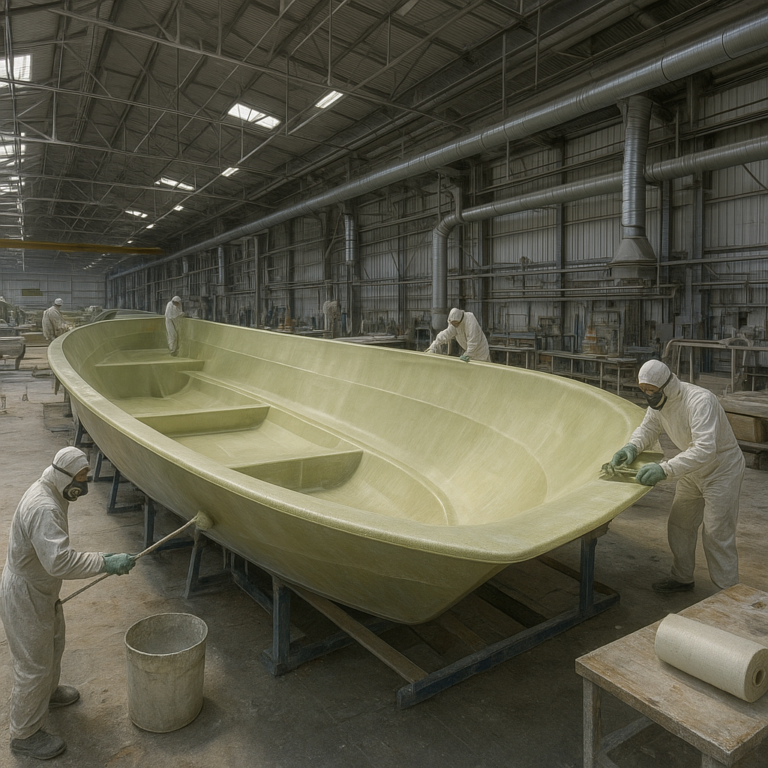
Fiberglass Boat Construction
Most mass-produced fiberglass boats use some combination of:
- Mold preparation
- Gelcoat application
- Fiberglass reinforcement
- Resin infusion or wet layup
- Core materials in selected panels
- Stringer and bulkhead installation
- Deck bonding
- Mechanical and electrical installation
- Engine installation
- Water testing and quality control
Modern methods can include vacuum infusion, resin infusion, and carefully engineered composite schedules. Our fiberglass boat builder guide explains why construction details matter.
Benefits:
- Smooth shapes
- Corosion resistance
- Repeatable molds
- Strong design flexibility
- Attractive finish
Drawbacks:
- Gelcoat damage
- Moisture intrusion if poorly maintained
- More difficult field repairs than aluminum
- Potentialy heavier than advanced composites
Aluminum, Steel, Carbon-Fiber, and Composite Hulls
| Material | Strengths | Weaknesses | Common uses |
|---|---|---|---|
| Aluminum | Light, durable, repairable | Can transmit noise and heat | Fishing, workboats, expedition boats |
| Fiberglass | Smooth, versatile, corrosion-resistant | Repair and moisture concerns | Recreational boats and yachts |
| Steel | Strong, economical for large vessels | Heavy, corrosion management | Ships and large yachts |
| Carbon fiber | Very light and stiff | Expensive and specialized | Racing and premium yachts |
| Advanced composites | Efficient strength-to-weight ratio | Complex manufacturing | Performance yachts and catamarans |
Serial Production vs. Hand-Built Yacht Construction
A production line aims for:
- Repeatability
- Efficient labor
- Consistent parts
- Predictable quality
- Faster dealer delivery
A custom yard prioritizes:
- Owner preferences
- Bespoke engineering
- Unique interiors
- One-off layouts
- High customization
Neither is automatically “better.” A production boat may be easier to service because thousands of similar parts exist. A custom yacht may offer extraordinary comfort but require specialized technicians.
Where the World’s Boats Are Built
Major boat-building regions include:
- United States
- France
- Italy
- Germany
- Netherlands
- United Kingdom
- Poland
- Spain
- Turkey
- Australia
- New Zealand
- Japan
- China
- Taiwan
Country of construction is only one part of the story. Design may happen in one country, engines may come from another, electronics from several more, and final assembly somewhere else.
How to Choose a Boat From a Major Manufacturer ✅
The biggest brand is not automatically the best brand for your boating life. Start with the mission, then choose the badge.
Best Boat Brands for Beginners
For first-time owners, prioritize:
- Simple systems
- Local dealer support
- Stable handling
- Easy trailering
- Readily available parts
- Clear safety equipment access
- Manageable operating costs
Good brands to investigate may include Bayliner, Jeanneau, Beneteau, Lund, Boston Whaler, Sea Ray, Yamaha-powered packages, and well-supported local builders.
A beginner-friendly boat is one you will actually use. An enormous, complicated boat can turn every weekend into a logistics exercise.
Best Manufacturers for Fishing and Offshore Cruising
For fishing, investigate:
- Boston Whaler
- Grady-White
- Pursuit
- Contender
- Scout
- Blackfin
- Robalo
- Cobia
- SeaVee
- Ranger
- Lund
- Sketer
For offshore cruising, examine:
- Jeanneau
- Beneteau
- Pursuit
- Sabre
- Back Cove
- Sea Ray
- Princess
- Viking
- Hatteras
Match hull design to water conditions. A shallow bay, exposed coast, Great Lake, and offshore canyon demand different compromises.
Best Brands for Pontoon Boats and Family Recreation
Consider:
- Harris
- Benington
- Crest
- Manitou
- Barletta
- Sun Tracker
- Sylvan
- Lowe
Pontons are excellent for social boating, swimming, fishing, and watersports. Their large deck area is the floating equivalent of a backyard patio, though windage can make docking more entertaining than expected.
Best Wakeboard, Wakesurf, and Watersports Boat Brands
The major premium names include:
- Malibu
- MasterCraft
- Nautique
- Centurion
- Axis
Compare:
- Ballast capacity
- Surf-system adjustment
- Engine torque
- Draft
- Storage
- Swim-platform design
- Tower height
- Service access
- Warranty
- Local technician expertise
👉 CHECK PRICE on:
- Malibu: Malibu Official Website | Boat Trader Malibu Search
- MasterCraft: MasterCraft Official Website | Boat Trader MasterCraft Search
- Nautique: Nautique Official Website | Boat Trader Nautique Search
Best Sailboat and Catamaran Manufacturers
Compare:
- Beneteau
- Jeanneau
- Bavaria
- Hanse
- Dufour
- Catalina
- Lagoon
- Fountaine Pajot
- Leopard Catamarans
- Bali Catspace
Inspect the boat’s intended use. A charter-oriented layout may maximize cabins and guest appeal, while a bluewater cruiser may prioritize tankage, redundancy, storage, and motion comfort.
Best Yacht Builders for Long-Range Cruising
Long-range buyers should investigate:
- Nordhavn
- Selene
- Kadey-Krogen
- Fleming
- Grand Banks
- Ocean Alexander
- Hatteras
- Azimut
- Princess
- Sanlorenzo
Evaluate:
- Fuel capacity
- Range at displacement speed
- Stabilization
- Redundant systems
- Generator capacity
- Watermaker access
- Engine-room ergonomics
- Spare-parts storage
- Crew or owner-operator requirements
Common Mistakes When Comparing Boat Brands ❌
Confusing Brand Ownership With Boat-Building Capacity
A parent company may own many brands but outsource some components or operate separate production facilities. More logos do not automatically equal more boats.
Always ask:
- Which company owns the brand today?
- Where is the specific model built?
- Is production shared with another brand?
- Are engines included in the parent company’s revenue?
- Are reported sales retail or wholesale?
Ignoring Dealer Networks and After-Sales Support
A boat can beautifully engineered and still become a headache if the dealer cannot source parts or schedule warranty work.
Before buying, call the service department and ask:
- How long is the typical wait for routine work?
- Which technicians are factory-trained?
- Can they diagnose the engine and boat systems?
- Are common parts stocked locally?
- Do they support older models?
This is where our Boat Buying Guide can help you build a smarter checklist.
Overlooking Hull Design, Warranty, and Resale Value
Do not compare logos alone. Inspect:
- Deadrise
- Flare
- Freeboard
- Transom design
- Stringer system
- Deck bonding
- Hardware backing plates
- Bilge access
- Electrical labeling
- Warranty exclusions
- Comparable resale listings
A flashy touchscreen cannot compensate for a cramped engine compartment or impossible-to-reach seacock.
Looking to Be the Captain of Your Own Yacht? 🧑 ✈️
Owning a yacht sounds romantic until you meet the maintenance schedule. The dream remains worth it, but it deserves arithmetic and preparation.
Boat Size, Licensing, and Training Requirements
Licensing rules vary by country, state, and vessel use. In the United States, many recreational operators do not need a federal captain’s license for private use, but state education requirements can apply. The U.S. Coast Guard boating safety resources and NASBLA provide authoritative guidance.
Commercial operation, chartering, carrying passengers for hire, and operating larger vessels may require credentials such as a USCG captain’s license.
Training worth considering:
- Basic boating safety
- VHF radio operation
- Navigation
- Weather interpretation
- Man-overboard recovery
- Docking practice
- Diesel systems
- First aid and CPR
Buying New vs. Buying a Used Boat
| New boat | Used boat |
|---|---|
| Latest systems and warranty | Lower entry cost and broader choice |
| Factory customization | Previous owner may have added equipment |
| Less unknown history | Requires careful survey and records |
| Immediate depreciation risk | Possible hidden maintenance |
| Dealer support | Strong value if condition is excellent |
A marine survey is money well spent, especially on larger or older boats. Engine diagnostics, moisture inspection, sea trial, and documentation review should happen before closing.
Ownership Costs Beyond the Purchase Price
Budget for:
- Insurance
- Storage
- Slip or moring
- Fuel
- Routine service
- Winterization
- Batteries
- Bottom paint
- Trailer maintenance
- Safety equipment
- Electronics updates
- Unexpected repairs
No specific price is universal because location and boat type dominate the result. A small trailerable fishing boat and a large yacht occupy entirely different financial galaxies.
Charter, Fractional Ownership, and Yacht Management
Alternatives to full ownership include:
- Bareboat charter
- Crewed charter
- Fractional ownership
- Yacht clubs
- Managed ownership
- Boat clubs
These options can reduce maintenance responsibility, but read contracts closely. Usage restrictions, blackout dates, damage policies, and management fees vary.
The Future of Boat Building 🌍
The next major boat-company rankings may be shaped less by hull volume and more by propulsion, software, energy storage, and sustainability.
Electric Boats and Hybrid Marine Propulsion
Electric propulsion is expanding in:
- Small tenders
- Inland day boats
- Harbor craft
- Canal boats
- Short-range ferries
- Low-speed recreational vessels
Battery weight, charging infrastructure, range, and energy density remain central constraints. The European Boating Industry provides useful policy and industry context.
Sustainable Materials and Cleaner Manufacturing
Manufacturers are exploring:
- Recycled composites
- Bio-based resins
- Lower-emission production
- More efficient hull forms
- Electric auxiliary systems
- Recyclable interior components
- Better end-of-life planning
The challenge is balancing durability, repairability, safety, and environmental impact. A material that looks green in a brochure but cannot be repaired or recycled may not solve the full lifecycle problem.
Smart Boat Technology and Connected Systems
Modern boats increasingly offer:
- Digital switching
- Joystick docking
- Engine monitoring
- Remote diagnostics
- Integrated navigation
- Automatic trim
- Surf and ballast presets
- Wireless controls
Technology helps, but it also creates new failure points. We like smart systems best when a manual backup, clear labeling, and a competent technician still exist.
Autonomous Boats and Emerging Marine Technologies
Autonomous and semi-autonomous systems are developing for:
- Surveying
- Commercial operations
- Marina logistics
- Defense
- Environmental monitoring
- Limited recreational assistance
For private boaters, the near-term future is more likely to involve collision alerts, docking assistance, route planning, and remote monitoring than a fully self-driving yacht replacing the skipper.
Useful Links for Boat Buyers and Boaters 📚
Boat Manufacturer Directories and Industry Associations
Safety, Registration, and Boating Education Resources
- U.S. Coast Guard Boating Safety
- National Association of State Boating Law Administrators
- BoatUS Foundation
- Transport Canada Office of Boating Safety
Boat Shows, Reviews, and Marine Market Data
Contact Us 📩
Have a boat-brand question, ownership story, or manufacturer correction? Visit Boat Brands™ and explore our Boat Brands, Boat Manufacturers, and Boat Buying Guide sections.
When comparing manufacturers, send us the details that matter:
- Boat type
- Length
- Intended waters
- Fishing, cruising, or watersports use
- New or used
- Trailerable or stored in-water
- Local dealer location
- Engine preference
That information turns a vague “Who makes the most boats?” question into the much more useful “Which builder makes the right boat for me?” question.